
How Much Does It Actually Cost to Move a Grand Piano in the Bay Area?
A comprehensive breakdown of pricing, hidden factors, and why hiring cheap movers to transport a Steinway or Yamaha is a catastrophic mistake.
Moving a grand piano is not merely a heavy lifting job; it is a specialized logistical operation. A grand piano is a complex instrument containing over 10,000 moving parts. It is extraordinarily heavy (weighing anywhere from 500 to 1,200 pounds), inherently fragile, and top-heavy. Its finish is highly susceptible to scratching, and its soundboard is highly sensitive to climate changes and physical shock.
If you live in the San Francisco Bay Area, you are likely wondering what the true cost is to transport such a delicate instrument across town or into a new multi-story home. While the instinct may be to find the lowest hourly rate, treating a piano move like a standard furniture move can lead to devastating consequences. Here is the reality of grand piano moving costs in 2026.
The True Cost Breakdown: Why $609 is the Absolute Minimum
In the Bay Area, the baseline cost to professionally move a grand piano starts at a strict minimum of $609 and can go upwards of $1,500 to $2,500+ for highly complex moves. If a company quotes you $300 or $400 over the phone, they are either a scam, an illegal broker, or an amateur crew lacking proper insurance and equipment. The $609 minimum exists because safely moving a piano requires an elite, highly trained rigging crew, specialized materials, and high-limit commercial cargo insurance.
- Upright vs. Grand vs. Concert Grand: An upright piano is relatively straightforward. A Baby Grand requires disassembly (removing the legs, pedals, and lid) and specialized piano sleds. A 9-foot Concert Grand requires a highly experienced crew of at least four to six riggers.
- Distance and Travel Time: Local moves within the Bay Area (e.g., from San Francisco to Palo Alto) will factor in fuel, bridge tolls, and vehicle time.
- Stairs and Elevators: This is the largest variable. Every single step matters. Navigating a steep, narrow San Francisco Victorian staircase with an 800-pound instrument is an entirely different operation than rolling it out of a ground-floor double door in Atherton.
Why You Can’t Hire “Cheap” Movers for a Piano
We frequently receive emergency calls from homeowners who initially hired budget movers, only to have the movers abandon the job halfway up a staircase, or worse, drop the instrument. Here is why specialized expertise is non-negotiable.
1. The Physics of the “Piano Board”
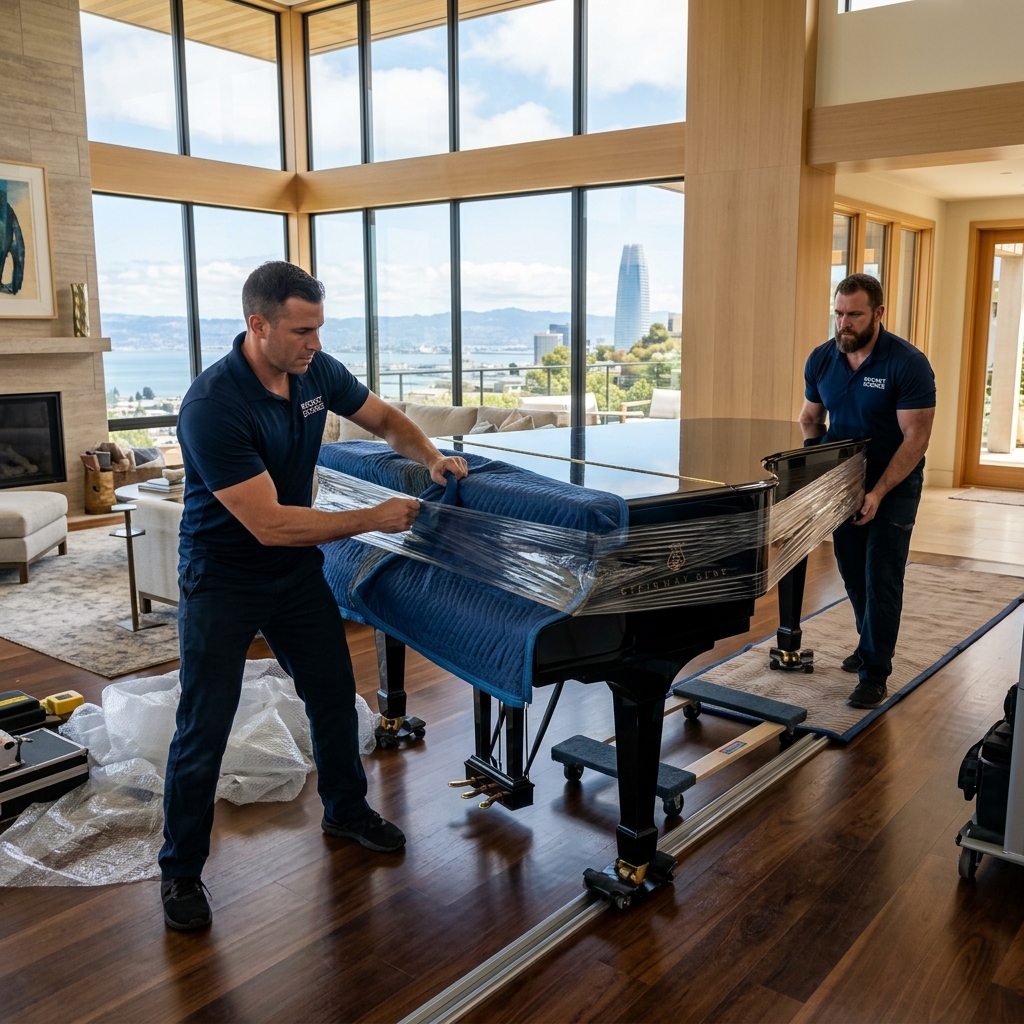
You cannot simply lift a grand piano and carry it. It must be dismantled, wrapped in thick quilted padding, and strapped tightly to a specialized “piano board” (a heavy-duty wooden sled). The piano is then tilted onto its straight edge. If the movers do not know the exact center of gravity, the 800-pound instrument will tip, crushing walls, floors, or the movers themselves.
2. Floor and Property Protection
A cheap mover will focus only on getting the piano out the door. Elite piano movers focus on the property. An 800-pound object rolling across luxury hardwood floors on standard casters will carve deep gouges into the wood. Professional teams use non-marring polyurethane wheels, neoprene floor runners, and Masonite boards to disperse the weight, ensuring zero damage to your home.
3. Climate and Tuning Stability
Pianos are highly sensitive to temperature and humidity. While moving a piano will almost always require a minor retuning once it settles, exposing it to extreme temperature fluctuations in a non-climate-controlled truck can warp the soundboard permanently. Specialized movers ensure the environment is stabilized.
What Goes Into a Professional Piano Moving Quote?
When you contact a professional moving company, they should ask you a series of highly specific questions. If a company gives you a flat rate over the phone without asking these questions, hang up.
- What is the exact make and model of the piano? (e.g., Steinway Model B, Yamaha C3). This tells the movers the exact weight and dimensions.
- Are there any stairs at the origin or destination? How many? Are there turns or landings?
- What is the flooring material at both locations? (Hardwood, carpet, tile, marble).
- Is there grass, gravel, or a steep driveway that the piano must roll over?
Insurance and Liability
Standard moving insurance is often calculated by weight (e.g., $0.60 per pound). If your $40,000 Steinway weighs 800 pounds, standard insurance will only pay out $480 if it is destroyed. This is unacceptable.
When hiring a piano mover in the Bay Area, you must verify that they carry comprehensive Cargo Insurance and General Liability insurance. This ensures that both the full replacement value of the instrument and the structural integrity of your home are fully covered in the event of an absolute worst-case scenario.
Conclusion
Moving a grand piano is a complex orchestration of physics, protective materials, and raw strength. The cost reflects the severe risk and specialized equipment required to execute the job flawlessly. When evaluating quotes, remember that you are not paying for labor; you are paying for peace of mind.